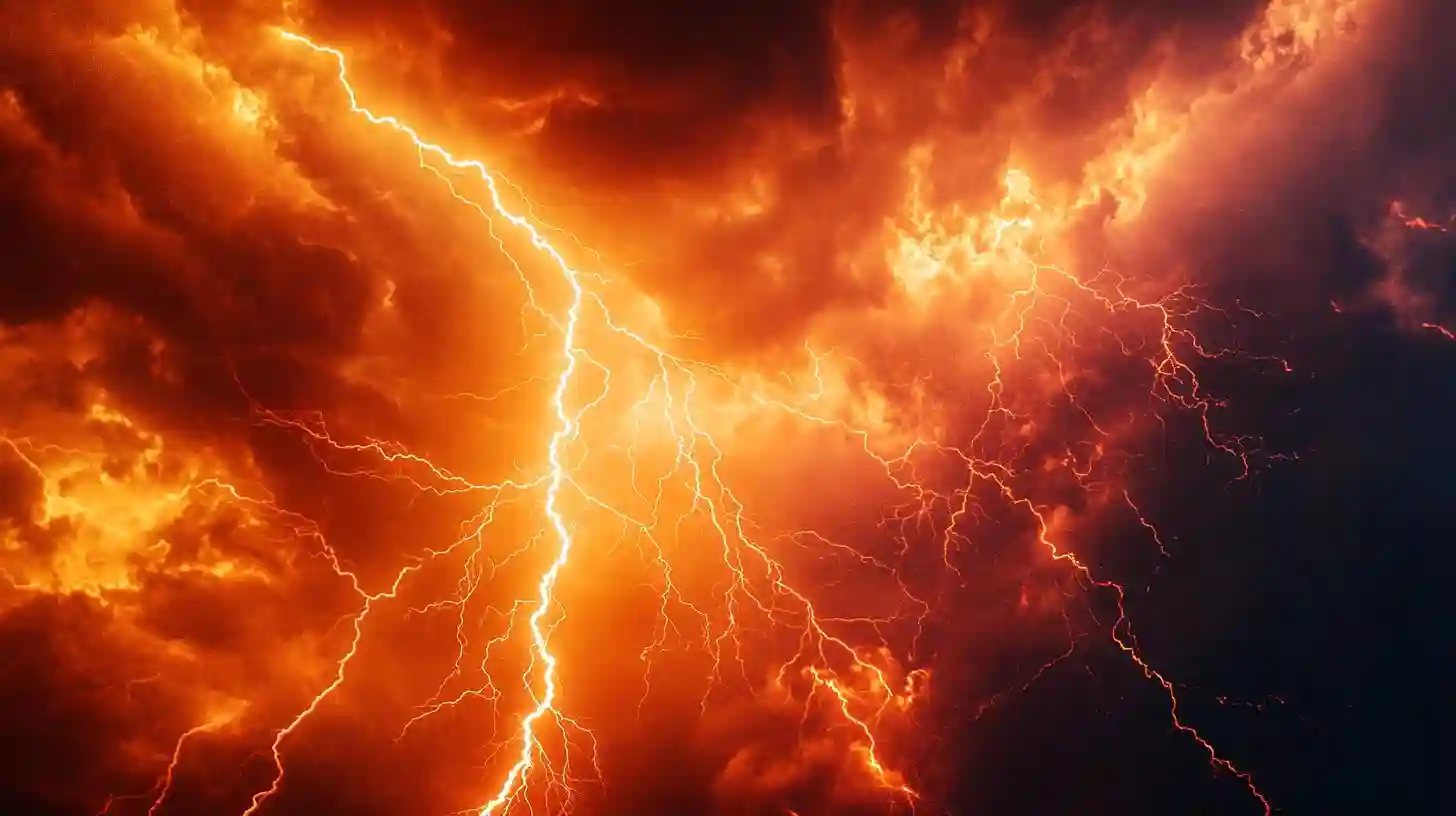
Lightning is one of nature's most fascinating and powerful phenomena. It captivates with its brilliance and the awe-inspiring energy it releases. When lightning strikes, it can create a spectacle of light and sound that is both mesmerizing and terrifying. To understand why lightning occurs, one must delve into the science behind this electrifying event.
The fundamental process begins in storm clouds, especially cumulonimbus clouds formed during thunderstorms. These clouds are characterized by their tall, towering structure and the intense atmospheric conditions they produce. Inside these clouds, water droplets and ice particles collide due to turbulence. This collision leads to a transfer of electrical charge, a process that is influenced by gravity and atmospheric conditions. The result is a separation of charges, where the top of the cloud accumulates positive charges, while negative charges build up at the bottom.
As the electrical charge separates, the buildup of negative charge at the base of the cloud creates a strong electric field between the cloud and the ground. The strength of this electric field can cause the air, which is normally an insulator, to become ionized. This ionization reduces the resistance of the air, making it possible for electrical discharge to occur. When the electric field becomes strong enough to overcome the electrical resistance of the air, a pathway for the electrical discharge is created.
The initial stage of a lightning strike is called the stepped leader. This is an invisible channel of ionized air that descends from the cloud toward the ground in a series of rapid, step-like motions. As the stepped leader moves downward, it creates a path for the electrical discharge. Simultaneously, the positive charges on the Earth's surface are attracted to the negative charges in the cloud. When the stepped leader gets close enough to the ground, a return stroke forms. This is the brightest and most visible part of the lightning strike. The return stroke travels back up the channel created by the stepped leader and carries the electrical charge from the ground back to the cloud.
There are different types of lightning, including intra-cloud lightning, cloud-to-cloud lightning, and cloud-to-ground lightning. Intra-cloud lightning occurs within the same cloud and is often the most common type. It can illuminate the cloud itself and may not be directly visible from the ground. Cloud-to-cloud lightning involves discharges between separate clouds, creating dramatic displays across the sky. However, it is the cloud-to-ground lightning that is most feared due to its potential to cause injury or damage.
The conditions that lead to lightning strikes can be further affected by environmental factors such as humidity, temperature, and wind patterns. Warm, humid air can enhance the development of thunderstorms, leading to more frequent lightning strikes. The presence of mountains or other geographical features can also influence how storms develop and where lightning is likely to strike.
Interestingly, the occurrence of lightning is not uniform around the world. Certain regions, particularly those near the equator or areas with high levels of moisture and heat, experience a greater frequency of lightning strikes. The tropics, for example, are often referred to as lightning hotspots due to the ideal conditions for thunderstorm formation. Conversely, areas with arid climates generally see fewer instances of lightning.
From a safety perspective, understanding lightning and its behavior is crucial. People often underestimate the dangers posed by lightning. It is a leading cause of weather-related deaths and injuries. Lightning can strike not only during thunderstorms but also in clear conditions, where it can travel considerable distances from the main storm. The best preventive measure against lightning strikes includes taking shelter indoors and avoiding open fields, tall trees, or metallic objects during a thunderstorm.
Moreover, the study of lightning extends beyond just understanding its formation and hazards. Researchers and scientists also explore the various effects of lightning on the atmosphere and ecology. Lightning plays a remarkable role in the nitrogen cycle, producing nitrogen oxides during strikes that can fertilize the soil. This interaction is an essential part of Earth’s ecosystem and demonstrates the intricate balance present in nature.
As science continues to advance, experts are developing more tools to study and predict lightning strikes, potentially reducing the risks associated with these sudden discharges of electricity. Predicting lightning remains complex, and scientists are working toward understanding its patterns better, which may lead to improved warning systems and public safety measures.
Lightning is an electrifying phenomenon that captures both the imagination and respect of those who witness it. Understanding its processes provides insight not only into atmospheric science but also into the balance of nature itself.